The Physics of "Placement": Why Singing in the Mask is Real (But Not How You Think)
Every singer has encountered the classical directives: “Sing in the mask.” “Send the sound out the top of your head.” “Place the voice in the roots of your upper teeth.”
If you approach a physicist or an acoustic scientist with these terms, they will tell you flatly that you cannot physically steer, place, or aim a sound wave into your sinus cavities. Sound waves propagate through the open spaces of the vocal tract and radiate outward from the mouth. You cannot command a sound wave to take a detour into your cheekbones.
This creates a massive disconnect in vocal pedagogy. On one side, we have old-school empirical imagery that yields real results but relies on scientific impossibilities. On the other side, we have raw anatomy and laryngeal mechanics that can leave a singer feeling trapped in their throat.
To bridge this gap, we have to look at the human voice through the lens of fluid dynamics and acoustic physics. Elite vocal technique relies on a precise mechanical reality: managing air pressure at the vocal folds to optimize efficiency. To understand how this works, we have to look outside of human anatomy entirely and examine a brass instrument.
To understand how the physics of the voice interlock, we have to separate local aerodynamics from global acoustics. The short answer is: the larynx gives you the Bernoulli effect automatically, but you cannot get acoustic inertance without precisely shaping the vocal tract.
Here is how the mechanics actually split between the throat and the resonator.
The Trumpet Blueprint: How Pressure-Gated Valves Work
To demystify how breath pressure turns into acoustic energy, look at how a trumpet player produces a tone.
A trumpet player does not simply blow air through an open pipe. Sound production requires an oscillator—a mechanism that breaks up a continuous stream of air into distinct, rapid pulses of pressure. For the trumpet player, that oscillator is the embouchure.
The player compresses their lips together, sealing the mouthpiece.
They drive breath pressure from the lungs against those closed lips.
When the pressure builds high enough, it forces the lips apart, releasing a small puff of air into the horn.
The natural elasticity of the lip tissue, combined with the drop in pressure, snaps the lips shut again.
This cycle repeats hundreds of times per second. The trumpet player’s lips act as a pressure-gated tissue valve.
The human larynx operates on this exact physical principle. Your vocal folds are the lips; your throat is the mouthpiece. The ultimate goal of singing technique is to learn how to manage the air pressure against this laryngeal valve so that it vibrates with maximum precision and minimum muscular strain.
Bernoulli vs. Inertance: The Local and the Global
The Bernoulli principle is an intrinsic aerodynamic default. It doesn't require complex tract tuning to turn on. If your vocal folds are adducted (closed) and you drive breath pressure against them, the air must accelerate as it passes through the narrow glottal slit. That acceleration causes an instantaneous drop in pressure, which sucks the folds back together. This happens entirely at the laryngeal level.
However, baseline Bernoulli mechanics only get you so far. To achieve elite vocal efficiency, you must activate acoustic inertance, which is an exclusively supraglottic (above-the-glottis) phenomenon.
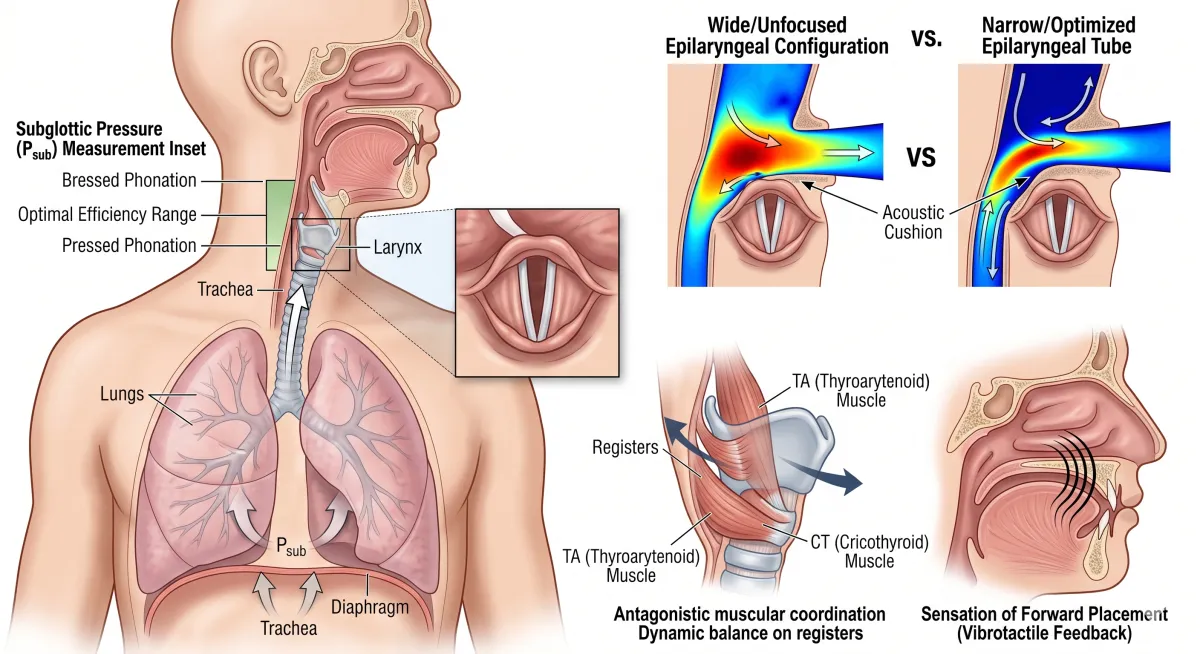
To get that acoustic cushion, you have to shape the resonator tube shown above. Specifically, you must create a structural mismatch: a narrowed epilaryngeal tube (the small collar directly above the folds) opening into a wider pharyngeal cavity.
When you configure the tract this way, the column of air directly above your larynx gains acoustic mass. It becomes "sluggish" (inertive). As the vocal folds blow open, this heavy air column resists moving, creating a temporary low-pressure vacuum right above the folds that helps pull them apart. When the folds start to close, the moving air column wants to keep rushing forward, creating a suction effect that snaps the folds shut faster than tissue elasticity alone ever could.
You cannot get this mechanical assist by focusing on the larynx alone; it requires deliberate, macro-level tuning of the throat and jaw.
The Reality of "Resonance" and "Placement"
When singers talk about "forward placement" or "singing in the mask," they are dealing with a brilliant psychophysical illusion.
From a strict physics standpoint, you cannot physically "place" a sound wave. Sound waves do not travel up into the sinus cavities or the bridge of the nose to vibrate in a vacuum; they follow the open acoustic pathway and radiate out of the mouth.
What singers are actually feeling when they experience "placement" is vibrotactile feedback.
When the vocal tract is tuned to a state of high acoustic inertance, the acoustic pressure waves inside the oral cavity and pharynx reach maximum amplitude. These intense sound pressure fluctuations physically strike the hard palate and tissue interfaces, sending sympathetic vibrations through the maxilla and facial bones (as mapped in the historic Lehmann diagram).
Resonance is the physical cause (the precise geometric tuning of the vocal tract filter).
Placement is the sensory effect (the felt vibration resulting from that tuning).
Focusing on "placement" is highly effective pedagogy because the human brain struggles to directly dictate the microscopic coordinates of the laryngeal muscles. Telling a singer to "feel the ring in the teeth" or "lock the sound in the mask" acts as a neurological shortcut. The brain translates that sensory goal into the exact motor commands needed to lift the soft palate, stabilize the larynx, and narrow the epilarynx automatically.
The Practical Takeaway: How to Stop Forcing and Start Tuning
When a singer doesn't understand this physics, they fall into a dangerous trap: they try to get a focused sound by using brute force at the larynx.
If you try to increase your "closed quotient" and get a sharper vocal edge purely by squeezing your throat muscles, you increase the throat's mechanical workload. You jam the vocal folds together harder, which forces your lungs to push with higher subglottic pressure to blow them open. This is the recipe for vocal fatigue, nodules, and chronic tension.
When you understand acoustic inertance, your strategy shifts completely:
Drop the jaw and stabilize the larynx: This maintains the wide pharyngeal cavity needed for the air column's mass.
Narrow the epilaryngeal collar: This is the internal narrowing (often felt as a slight, bright "twang" or a narrow tracking in the deep throat) that triggers the acoustic mismatch.
Trust the sensations: Stop checking your throat for feedback. Look for the vibrotactile "buzz" in the hard palate, teeth, or facial bones.
If you configure the resonator correctly, the acoustic backpressure does the physical work of snapping your vocal folds shut for you. You achieve a focused, piercing, resonant sound with a fraction of the muscular effort. You aren't forcing the valve; you are tuning the pipe.
*Prefer reading via RSS? Subscribe to my Vocal Anatomy Lab Feed >>> HERE.